

How To Draw Oxygen In Water
The Configuration of the H2o Molecule
 Print
Print
The Configuration of the H2o Molecule
A molecule of h2o is composed of two atoms of hydrogen and one atom of oxygen. The one and only electron ring around the nucleus of each hydrogen atom has simply one electron. The negative charge of the electron is counterbalanced by the positive charge of 1 proton in the hydrogen nucleus. The electron ring of hydrogen would actually prefer to possess 2 electrons to create a stable configuration. Oxygen, on the other hand, has two electron rings with an inner ring having 2 electrons, which is cool because that is a stable configuration. The outer ring, on the other hand, has six electrons simply it would like to have 2 more because, in the second electron ring, 8 electrons is the stable configuration. To balance the negative charge of eight (2+6) electrons, the oxygen nucleus has 8 protons. Hydrogen and oxygen would like to have stable electron configurations but practice not as individual atoms. They can get out of this predicament if they hold to share electrons (a sort of an energy "treaty"). So, oxygen shares 1 of its outer electrons with each of two hydrogen atoms, and each of the two hydrogen atoms shares it's one and only electron with oxygen. This is called a covalent bond. Each hydrogen atom thinks information technology has two electrons, and the oxygen atom thinks that it has viii outer electrons. Everybody's happy, no?
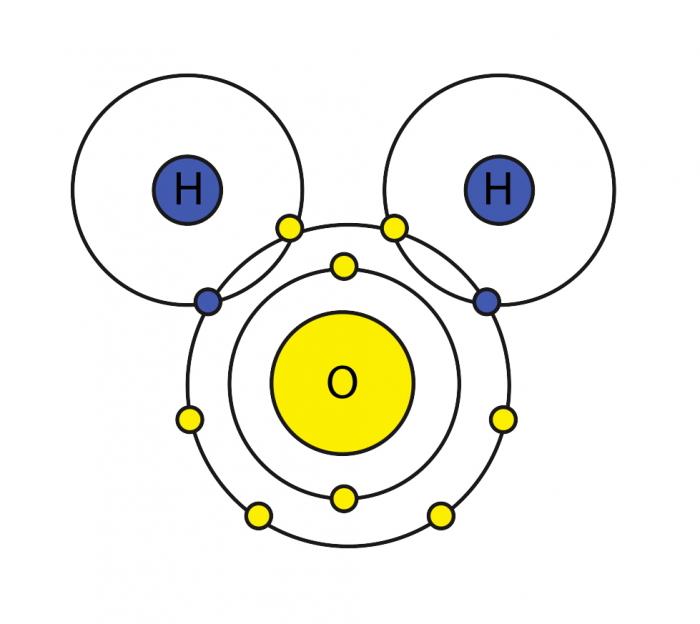
Effigy 1. H2o Molecule
Source: Maureen Feinman
However, the 2 hydrogen atoms are both on the same side of the oxygen atom then that the positively charged nuclei of the hydrogen atoms are left exposed, so to speak, leaving that end of the water molecule with a weak positive charge. Meanwhile, on the other side of the molecule, the excess electrons of the oxygen atom, give that end of the molecule a weak negative change. For this reason, a water molecule is chosen a "dipolar" molecule. Water is an example of a polar solvent (one of the best), capable of dissolving about other compounds because of the water molecule's diff distribution of accuse. In solution, the weak positively charged side of 1 water molecule will exist attracted to the weak negatively charged side of another h2o molecule and the two molecules will exist held together by what is chosen a weak hydrogen bail. At the temperature range of seawater, the weak hydrogen bonds are constantly being broken and re-formed. This gives water some structure merely allows the molecules to slide over each other easily, making it a liquid.

Source: https://www.e-education.psu.edu/earth111/node/838
Posted by: gallowaycusese.blogspot.com
0 Response to "How To Draw Oxygen In Water"
Post a Comment